2008-12-05
| 00:15 | hiredman | clojurebot: latest is 1144 |
| 00:15 | clojurebot | Alles klar |
| 00:16 | clojurebot | svn rev 1145; made RT.DEFAULT_COMPARATOR use Util.compare |
| 01:05 | bradbev | I'm having trouble using compile because of classpath reasons. I have /foo/ in my classpath, and my file is /foo/bar/main.clj (compile 'bar.main) gives "No such file or directory (main.clj):1) I can't figure out what I'm doing wrong :( |
| 01:08 | hiredman | do you have ./classes in your classpath? |
| 01:08 | hiredman | well |
| 01:08 | hiredman | it needs to be ./classes/ |
| 01:09 | hiredman | I think the last slash in important |
| 01:11 | bradbev | hmm, I've just found that |
| 01:11 | bradbev | and, no |
| 01:11 | bradbev | so I guess I should fix that.... |
| 01:13 | bradbev | ah, thanks - that was it |
| 01:13 | hiredman | np |
| 01:43 | bradbev | maybe I'm doing this wrong. What is the best way to compile AOT my clojure files? using (compile ...) or the standalone compiler? |
| 06:38 | blackdog | wherre can i find the syntax hilighter used on clojure.org? |
| 07:53 | rhickey | I'm considering - auto mem-fning - given Classname.methodname in value position, create (possibly arity-overloaded) fn |
| 08:23 | gnuvince | hello |
| 08:26 | rhickey | gnuvince: hey |
| 08:27 | tomhickey | blackdog: clojure.org is using Dan Webb's codehighlighter script, http://svn.danwebb.net/external/CodeHighlighter/ |
| 08:27 | blackdog | ah thanks |
| 08:27 | gnuvince | rhickey: how's it going? |
| 08:28 | rhickey | well |
| 08:28 | blackdog | tomhickey, do you have a clojure style? |
| 08:28 | blackdog | for addStyle() |
| 08:28 | blackdog | no worries i'll find it one the site |
| 08:29 | tomhickey | blackdog: http://clojure.org/file/view/clojure.js |
| 08:29 | blackdog | ok, thanks! |
| 08:29 | tomhickey | it's not the best regex, but it works |
| 08:30 | blackdog | np |
| 08:30 | gnuvince | tomhickey: hopefully you had a script to generate that function regex ;) |
| 08:31 | tomhickey | gnuvince: with help from rich, yes ;) |
| 08:47 | Chouser | rhickey: cool! Constructors too? (map Integer. (.split "1 2 3")) |
| 08:48 | rhickey | Chouser: why not? (while we're talking vaporware ::) |
| 08:48 | Chouser | :-) |
| 08:49 | rhickey | Only considering this because if not overloaded on type for same arity, I can make non-reflective |
| 08:50 | rhickey | so you'll want to map Integer/parseInt |
| 08:51 | rhickey | hmm... longer than #(Integer. %) |
| 08:51 | Chouser | You can tell at compile time that map will be passing in one arg? |
| 08:52 | rhickey | No, I'll make an arity-overloaded fn for all arities for method |
| 08:52 | Chouser | yeah, I noticed that. But 80% less line noise. |
| 08:52 | Chouser | oh, sure. |
| 08:52 | rhickey | so, efficient, _and_ apply will work |
| 09:10 | AWizzArd | rhickey: what would the other solutions look like? One is efficient but doesn't work with apply? |
| 09:11 | rhickey | AWizzArd: ? |
| 09:13 | AWizzArd | you said it is efficient plus that apply will work |
| 09:13 | rhickey | AWizzArd: what more could you want? |
| 09:13 | AWizzArd | It sounded as if there was a solution where at least one of those two characteristics wouldn't be true. |
| 09:13 | AWizzArd | I like it :-) |
| 09:13 | rhickey | you can't apply methods now |
| 09:14 | AWizzArd | I am just curious what the alternative would be |
| 09:14 | AWizzArd | oh I see |
| 09:14 | rhickey | memfn is reflective |
| 09:14 | rhickey | as is jcall etc |
| 09:59 | AWizzArd | (def x {1 2 3 4}) <-- how can I flatten this into (1 2 3 4)? |
| 09:59 | Chouser | (apply concat x) |
| 09:59 | AWizzArd | sure, thx |
| 09:59 | Chouser | but the pairs might come out in a different order |
| 10:00 | AWizzArd | right |
| 10:00 | AWizzArd | although a key/value pair will always be together |
| 10:00 | Chouser | yes |
| 10:06 | AWizzArd | Is JavaFX interesting? Today I read the first time about it. |
| 10:08 | tomhickey | is there anything like merge that will also merge values if they are maps? e.g. i want (merge {:a {:x 1 :y 2}} {:a {:x 3 :b 2}}) to give me back {:a {:x 3 :y 2 :b 4}} |
| 10:08 | rhickey | Chouser: any better name for scanl for Clojure? just scan? |
| 10:09 | blackdog | it looks interesting but I'm a bit worried about the need to use a proprietary tool to create cross platform content, completely stupid - anyhoo, i think by using scenario.jar from clojure could get most of the same |
| 10:09 | RSchulz | tomhickey: It sounds like you want a multimap |
| 10:09 | rhickey | user=> (merge-with merge {:a {:x 1 :y 2}} {:a {:x 3 :b 2}}) |
| 10:09 | rhickey | {:a {:x 3, :y 2, :b 2}} |
| 10:09 | RSchulz | It seems like multimap and multiset would be good things to have in Contrib. |
| 10:10 | AWizzArd | What is scanl doing? |
| 10:10 | Chouser | (scanl + 10 [1 2 3 4]) ==> (10 11 13 16 20) |
| 10:10 | gnuvince | Did you guys catch the nice quote from Raganwald in his Ruby.rewrite(Ruby) pr�sentation? |
| 10:10 | rhickey | RSchulz: I don't know that multimaps/sets are really different data structures, just functions that treat maps and sets a certain way |
| 10:10 | gnuvince | "Whatever feature your IDE gives you is a design flaw in your programming language" |
| 10:11 | tomhickey | rhickey: thanks |
| 10:11 | Chouser | Haskell's scanr doesn't seem very clojury, but just 'scan' reminds me of reading from stdin in C |
| 10:11 | RSchulz | Well, multisets have to count their members, so they could be implemented with maps, of course, and multimaps can be maps whose values are sets. |
| 10:11 | AWizzArd | I think scanl is not too bad. |
| 10:12 | rhickey | scanl = ick |
| 10:12 | AWizzArd | l stands for left? |
| 10:12 | Chouser | scanl is like reduce that emits a new item for each iteration |
| 10:12 | RSchulz | What is the "scanl" you're talking about. I don't see it anywhere. |
| 10:12 | stuarthalloway | why is the ordering in sets sometimes inconsistent when the sets contain identical data? |
| 10:13 | rhickey | RSchulz: http://paste.lisp.org/display/68046#3 |
| 10:13 | stuarthalloway | I know you can't count on the ordering, but it surprises me that it changes from one run to the next with identical data |
| 10:13 | gnuvince | RSchulz: from Haskell |
| 10:13 | Chouser | 'scan-reduce'? |
| 10:13 | AWizzArd | left-scan, scan-left, scan-reduce |
| 10:13 | RSchulz | What's the concept? |
| 10:14 | AWizzArd | RSchulz: (04:10:28 PM) Chouser: scanl is like reduce that emits a new item for each iteration |
| 10:14 | rhickey | reduce-seq? |
| 10:14 | RSchulz | How is it not map, then? |
| 10:14 | AWizzArd | RSchulz: how does the map for (04:08:17 PM) Chouser: (scanl + 10 [1 2 3 4]) ==> (10 11 13 16 20) look like? |
| 10:14 | Chouser | RSchulz: did you see my example run above? try writing it with just 'map' |
| 10:14 | rhickey | RSchulz: there's a propagation from one call to the next |
| 10:15 | RSchulz | I see. |
| 10:15 | rhickey | reduce-keep |
| 10:15 | RSchulz | The name is kind of arbitrary. |
| 10:15 | Chouser | I was actually using the name 'propagate' before rhickey reminded me we'd been over this before. |
| 10:15 | RSchulz | Yes, reduce-keep is at least somewhat descriptive. Scan certainly isn't. |
| 10:15 | rhickey | reduces |
| 10:16 | Chouser | ooh |
| 10:16 | Chouser | if that's not too subtle, I like it. |
| 10:17 | rhickey | reduces == as defined by my lazy scanl? |
| 10:18 | Chouser | sure, how else would it be defined? |
| 10:18 | AWizzArd | something with a ,,-" inside sounds lispy, but is long. So reduces looks nicer to me |
| 10:18 | rhickey | just asking, you had a strict one and had been playing with it |
| 10:19 | Chouser | oh, eager? no. lazy is good. |
| 10:19 | RSchulz | Maybe "reducing"? |
| 10:20 | AWizzArd | reducify :-) |
| 10:21 | AWizzArd | step-reduce |
| 10:22 | rhickey | reduce [f init coll] - "Returns a lazy seq of the intermediate values of the reduction (as |
| 10:22 | rhickey | per reduce) of coll by f, starting with init" |
| 10:22 | rhickey | er, reduces |
| 10:23 | rhickey | reduction? |
| 10:24 | AWizzArd | that sounds too much like reduce |
| 10:24 | AWizzArd | condense |
| 10:25 | gnuvince | What are we naming? |
| 10:25 | gnuvince | scanl? |
| 10:25 | AWizzArd | yes |
| 10:25 | Chouser | Does it make any sense for 'init' to be optional as it is in reduce? |
| 10:26 | rhickey | Chouser: yes - you sending patch? |
| 10:26 | Chouser | heh. can do. |
| 10:26 | gnuvince | continuously? |
| 10:26 | gnuvince | Nah, doesn't work... |
| 10:26 | rhickey | reduction |
| 10:27 | RSchulz | (As Marge Simpson said--funny, I was just thinking about that episode earlier--"Names are hard.") |
| 10:27 | gnuvince | Not sure about reduction; you have reduce which returns a single value, so you'd expect reduction to do something similar. |
| 10:27 | rhickey | I'm sure |
| 10:28 | AWizzArd | slash? taper? |
| 10:28 | rhickey | it describes the process of reducing |
| 10:28 | RSchulz | Crush? |
| 10:28 | Chousuke | accumulate? :/ |
| 10:28 | RSchulz | Too side-effecty. |
| 10:28 | RSchulz | Actually, though, accumulate doesn't sound bad. |
| 10:29 | gnuvince | It's not bad, but again, I feel that htis conveys that you'll get a final, atomic value. |
| 10:29 | AWizzArd | gnuvince: it sounds very much like reduce, yes |
| 10:30 | rhickey | user=> (reduce + 0 [1 2 3 4]) |
| 10:30 | rhickey | 10 |
| 10:30 | rhickey | user=> (reduction + 0 [1 2 3 4]) |
| 10:30 | rhickey | (0 1 3 6 10) |
| 10:31 | RSchulz | "Peephole?" |
| 10:31 | RSchulz | Too risque? |
| 10:31 | AWizzArd | I personally think that reduce sounds more like producing (0 1 3 6 10) and reduction will return the final reduction of this expression. |
| 10:32 | AWizzArd | reduction gives you the reduction, while reduce as a verb sounds more active imo |
| 10:32 | gnuvince | I guess we can talk about this all day, but the BDFL has decided on reduction ;) |
| 10:32 | RSchulz | Is this function, whatever it ends up being called, going into Contrib? Core? |
| 10:33 | rhickey | AWizzArd: It's not a subjective thing - reduction: the action of making something smaller, reduce: to make something smaller |
| 10:34 | AWizzArd | What about minify? ;-) |
| 10:34 | Chousuke | maybe call it "reductions" as it produces the reduction of every subsequence. |
| 10:34 | AWizzArd | also nice |
| 10:35 | AWizzArd | bestest name so far |
| 10:36 | RSchulz | But nothing is being made smaller here, is it? |
| 10:37 | AWizzArd | "reductions" even has the flair of lazyness |
| 10:37 | RSchulz | There is no aspect of decreasing (-ness) about it, right? |
| 10:37 | rhickey | RSchulz: reduce does, reduction is the enumerated process of reduce |
| 10:37 | RSchulz | Yes, reduce does, but this new thing we don't want to call scanl does not. |
| 10:38 | RSchulz | Also, does it generalize in any way to larger scopes over which the individually applied actions operate within the target sequence? |
| 10:38 | RSchulz | Or is it strictly pair-wise? |
| 10:38 | rhickey | it is the intermediate results of reduce |
| 10:39 | rhickey | i.e. the reduciton |
| 10:39 | rhickey | reeduction |
| 10:39 | rhickey | reduction |
| 10:39 | AWizzArd | *g* |
| 10:39 | RSchulz | Nah. Spelling's only important to computers. And publishers. |
| 10:39 | AWizzArd | Btw, it is very cheap to rseq a vector yes? So reducing from the right side is no problem. |
| 10:40 | rhickey | AWizzArd: for anything reversible, including vector |
| 10:43 | RSchulz | I wonder if mapcat offers a naming precedence that should be respected? |
| 10:43 | RSchulz | _precedent_, that is. |
| 11:17 | drewolson | i'm having some AOT compilation issues. I'm trying to run a file consisting of unit tests. It's definitely in my path the java can't find it |
| 11:18 | drewolson | are namespaces with "-" an issue in AOT? |
| 11:18 | Chouser | drewolson: shouldn't be, but they are converted to "_" in class, file, and directory names. |
| 11:18 | drewolson | Chouser: yep, and i see the outputed classes are named exactly like that |
| 11:19 | drewolson | however, when i run java, it doesn't want to find my class files |
| 11:19 | drewolson | the command is basically: |
| 11:19 | drewolson | java -cp clojure.jar:clojure-contrib.jar:classes:test/classes org.drewolson.test-foo |
| 11:20 | drewolson | and the comipled test classes is sitting in test/classes/org/drewolson/foo |
| 11:20 | drewolson | s/comipled/compiled/ |
| 11:20 | Chouser | try: org.drewolson.test_foo |
| 11:20 | drewolson | k |
| 11:20 | Chouser | java's expecting a class name there, which can't have "-" |
| 11:20 | drewolson | that did the trick, thanks :) |
| 11:21 | Chouser | np |
| 11:23 | drewolson | hrm, still not convinced i'm actually running the file |
| 11:24 | drewolson | no errors now, but i don't see any test output |
| 11:24 | drewolson | i should be able to include :gen-class in my ns macro and then call (run-tests) from -main, correct? |
| 11:28 | drewolson | i take that back, it's working fine |
| 11:28 | drewolson | ant just doesn't print output :) |
| 11:40 | Chouser | clojurebot: atom discussion is http://groups.google.com/group/clojure/msg/fd0371eb7238e933 |
| 11:40 | clojurebot | 'Sea, mhuise. |
| 11:40 | Chouser | clojurebot: brain dump? |
| 11:40 | clojurebot | brain dump is http://clj.thelastcitadel.com/clojurebot |
| 11:42 | Chouser | rhickey: you saw cgrand's timing tests of vector vs. closure creation? |
| 11:44 | drewolson | ok, i'm going crazy: http://gist.github.com/32396 |
| 11:44 | drewolson | that runs fine, but outputs nothing |
| 11:44 | drewolson | the tests aren't running and i have no idea why |
| 11:49 | Chouser | drewolson: no output, or "Ran 0 tests"? |
| 11:49 | drewolson | Chouser: no output at all |
| 11:50 | Chouser | pre-compiled only, or also when run from .clj sources? |
| 11:50 | drewolson | how would i run this from the .clj sources? |
| 11:50 | drewolson | would main run? |
| 11:51 | drewolson | right now i'm running the compiled code |
| 11:51 | Chouser | you could start a clojure repl, then: (require 'org.drewolson.test-dragon) (org.drewolson.test-dragon/-main) |
| 11:52 | drewolson | let me give that a shot |
| 11:53 | Chouser | I think I'm reproducing your error, and I think it has to do with *test-out* |
| 11:53 | drewolson | hrm, i see |
| 11:53 | drewolson | Chouser: yes, tests do run from the repl |
| 11:55 | drewolson | Chouser: i take that back...i see output, but it says "0 tests run" |
| 11:55 | drewolson | somehow, running (run-tests) from main is not seeing the deftest declarations |
| 11:57 | Chouser | drewolson: yes, it looks like you have to say: (run-tests 'org.drewolson.test-dragon) |
| 11:57 | drewolson | ah, i see |
| 11:58 | drewolson | Chouser: ok, tests now run from the Repl, but still nothing running the compiled class from the command line |
| 11:59 | drewolson | Chouser: or, at least, i can't see the output, i'll look into *test-out* |
| 12:00 | Chouser | If i write directly to *out* and *test-out* from inside the compiled -main, I see neither. |
| 12:00 | Chouser | but prn works |
| 12:00 | drewolson | hrm, very strange |
| 12:01 | drewolson | i'm trying to get a feel for how i would unit tests apps in clojure, not sure how else to do it |
| 12:02 | Chouser | ah, manual flush is required |
| 12:02 | drewolson | Chouser: not sure I understand, can you pastie? |
| 12:02 | Chouser | http://gist.github.com/32403 |
| 12:02 | drewolson | awesome, thanks |
| 12:02 | drewolson | god bless gist |
| 12:03 | drewolson | although hooks into irc would be nice. notification similiar to the lisp paste site you use |
| 12:03 | Chouser | yeah, I've not used it much. seems pretty nice, plus it even colors Clojure nicely. |
| 12:03 | Chouser | drewolson: yes, if it had that, I'd definitely prefer gist. |
| 12:03 | drewolson | yep. |
| 12:04 | drewolson | i'm wondering how i would create a test suite, roll all my tests into a single run |
| 12:04 | drewolson | but have them in multiple files |
| 12:04 | Chouser | drewolson: I've done nothing with test-is (or any other clojure test framework for that matter), so I'm the wrong one to ask. |
| 12:05 | drewolson | gotcha, thanks for the help |
| 12:05 | Chouser | if nobody else here chimes in, you could bring it up on the google group. |
| 12:08 | drewolson | maybe i'll see if i can actually write some code to solve it |
| 12:09 | dudleyf | I'm kind of leaning towards specjure for testing |
| 12:09 | dudleyf | but I haven't used it extensively |
| 12:09 | duck1123 | does anyone know if there is a gist mode for emacs? |
| 12:09 | drewolson | duck1123: there is |
| 12:09 | drewolson | duck1123: http://github.com/defunkt/gist.el/tree/master |
| 12:10 | duck1123 | drewolson: thanks. I'll check it out |
| 12:10 | drewolson | np |
| 12:10 | dudleyf | heh |
| 12:10 | dudleyf | The first result for "gist irc bot" is clojurebot |
| 12:12 | hiredman | clojurebot: copious is <reply>pffft, I'll give you copious, hiredmn's free time is copious |
| 12:12 | clojurebot | 'Sea, mhuise. |
| 12:12 | hiredman | clojurebot: waht can you tell me about the copious amount of russian spam I recieve? |
| 12:12 | clojurebot | pffft, I'll give you copious, hiredmn's free time is copious |
| 12:14 | RSchulz | And now it knows a typo forever... |
| 12:16 | RSchulz | Yeah, you reach inside its brainbox. Creepy. |
| 12:16 | hiredman | actually I just privmsg... |
| 12:17 | RSchulz | It's good you have such copious free time. |
| 12:25 | hiredman | lisppaste8: url? |
| 12:25 | lisppaste8 | To use the lisppaste bot, visit http://paste.lisp.org/new/clojure and enter your paste. |
| 12:25 | blackdog | i want to start with a map then conj onto it based on a variet of predicates - is there a nice way of doing that? it's almost like a (when) but it returns the original map if the predicate is false |
| 12:26 | blackdog | i guess a short macro will do the trick |
| 12:27 | lisppaste8 | hiredman pasted "chute example" at http://paste.lisp.org/display/71645 |
| 12:30 | hiredman | oops |
| 12:30 | hiredman | I missed a spot there |
| 12:31 | lisppaste8 | hiredman annotated #71645 with "missed a spot" at http://paste.lisp.org/display/71645#1 |
| 13:13 | AWizzArd | rhickey: What do you see as core parst that you still wish to see integrated into Clojure before 1.0? |
| 13:54 | rhickey | Chouser: I did see that - closure creation is fast, that's ok by me |
| 13:56 | Lau_of_DK | Good evening gents |
| 13:56 | gnuvince | I'm not an agent, I'm a ref! |
| 13:56 | gnuvince | </retarded Clojure-related joke> |
| 13:57 | Lau_of_DK | hehe |
| 13:57 | Lau_of_DK | gnuvince: I had a horrible experience at work, where I said "Its wonderful to work with streams that are infinate in length.... unless you accidentally print them", and then I almost choked laughing, and when I stopped, I realise nobody else thought it was funny / knew what a stream was :( |
| 13:58 | gnuvince | Hahahaha |
| 13:59 | technomancy | heh |
| 13:59 | gnuvince | Lau_of_DK: without wanting to diss your co-workers, isn't that the root of the problem in the computer software industry: people who don't know? |
| 13:59 | gnuvince | I'm not saying I'm better than other programmers, I'm definitely not. |
| 14:00 | gnuvince | But you wouldn't see a doctor asking what a CAT scan is... |
| 14:00 | Lau_of_DK | gnuvince: I think primarily the problem is actually religious attitude |
| 14:01 | Lau_of_DK | +s |
| 14:01 | Lau_of_DK | I have spoken with people who would defend PHP to death instead of looking twice at Lisp |
| 14:02 | Lau_of_DK | And Im not speaking CEO level or any such thing, but just programmers who have found their comfort zone, and love it |
| 14:02 | technomancy | Lau_of_DK: see the first quote on this page: http://technomancy.us/27 |
| 14:02 | technomancy | Leo Tolstoy agrees! |
| 14:03 | gnuvince | Lau_of_DK: yeah, it is a problem too, though one that I can understand. |
| 14:04 | Lau_of_DK | technomancy: My goodness, what a wonderful insightful quote |
| 14:05 | Lau_of_DK | But I cant get annoyed, in the end it plays out to my advantage |
| 14:05 | gnuvince | If it doesn't turn into zeal, I guess it can be useful. "You can't do X in language Y" "Oh yeah?! <hack hack hack>" |
| 14:06 | Lau_of_DK | "Zeal is its own excuse" |
| 14:08 | hiredman | hmmm |
| 14:08 | Chouser | technomancy: great quotes! |
| 14:08 | hiredman | clojurebot look up needs to be case insensitive |
| 14:09 | technomancy | Chouser: thanks. I like the last one too. =) |
| 14:09 | Lau_of_DK | hiredman: Isnt ^i the regex suffix for case-ignorance? |
| 14:09 | hiredman | clojurebot: Richard Stallman is <reply>who? |
| 14:09 | clojurebot | Titim gan �ir� ort. |
| 14:09 | gnuvince | Lau_of_DK: /foo/i |
| 14:09 | Lau_of_DK | k |
| 14:09 | hiredman | Lau_of_DK: but I am using keys in a hash for lookup |
| 14:09 | Lau_of_DK | gnuvince: you cant to that in ASM |
| 14:10 | Lau_of_DK | hiredman: so you gotta run it all in lower-case? |
| 14:10 | hiredman | I think I will have to do that |
| 14:10 | hiredman | but, meh, later |
| 14:10 | Lau_of_DK | hhe |
| 14:10 | Lau_of_DK | +e |
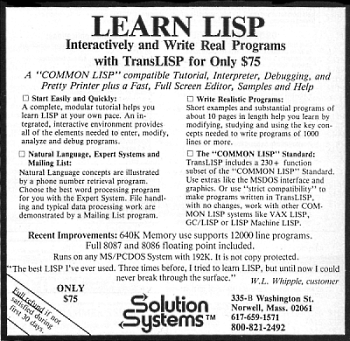
| 14:15 | hiredman | http://img.thedailywtf.com/images/ads/Learn-Lisp-small.png <-- learn lisp, only $75 |
| 14:17 | duck1123 | W.L. Whipple likes it |
| 14:18 | duck1123 | "Interactively and Write Real Programs with TransLISP for Only $75" |
| 14:18 | technomancy | what a deal. |
| 14:19 | technomancy | ... and people wonder if you can go anywhere as a language using primarily proprietary implementations. |
| 14:19 | technomancy | "Sure you can, that's why everyone is using Smalltalk these days." |
| 14:20 | Lau_of_DK | I know this question has been asked a million times before, but besides viaWeb, what larger projects have been done in a Lisp ? |
| 14:20 | technomancy | Emacs. =) |
| 14:20 | technomancy | autocad is another big one |
| 14:20 | Lau_of_DK | technomancy: Emacs is written in C |
| 14:20 | technomancy | and there's that big airline scheduling system by ITA |
| 14:20 | AWizzArd | Emacs is written in Elisp |
| 14:20 | technomancy | Lau_of_DK: Emacs Lisp is implemented in C. |
| 14:21 | Lau_of_DK | AWizzArd: Emacs is written in C, its a Elisp interpreter |
| 14:21 | Lau_of_DK | We're repeating each other, but the answer is still, its not written in Lisp |
| 14:21 | AWizzArd | some parts of it are written in c, yes |
| 14:21 | technomancy | ITA definitely has the biggest Lisp system in production to my knowledge. |
| 14:22 | duck1123 | most of the cool stuff I use in emacs *is* written in elisp |
| 14:22 | technomancy | unless some other folks are keeping it secret for a competitive advantage. |
| 14:22 | AWizzArd | I think ITA employs around 100 Lisp developers. |
| 14:22 | Lau_of_DK | uuh, cool |
| 14:24 | technomancy | anyway, there's significantly more lisp in Emacs than C, and since lisp is more expressive, the amount of functionality that's actually implemented in C is pretty slim. |
| 14:24 | AWizzArd | Yes |
| 14:24 | AWizzArd | We can say that Emacs is not purely written in Lisp |
| 14:25 | AWizzArd | What about Clojure? Is it written in Java or Clojure? |
| 14:25 | AWizzArd | Which part is bigger? |
| 14:25 | AWizzArd | Currently it's both, but the Clojure part is growing. |
| 14:25 | technomancy | the java part is bigger, but it's much less expressive |
| 14:26 | technomancy | plus everyone uses clojure contrib; that's got to count for something. |
| 14:26 | AWizzArd | rhickey probably has his reasons why he does not want to rewrite the java parts in Clojure, now as its compiler is bootstrapped. |
| 14:26 | kotarak | There are two parts of Cojure: the Java part building the infrastructure and the core library running on the Java part. |
| 14:26 | duck1123 | do you consider things like dired, erc, proced, etc. to be part of emacs, or applications that run on the emacs platform? |
| 14:27 | Chousuke | how much of emacs is non-elisp that doesn't actually involve interpreting elisp :P |
| 14:28 | duck1123 | Chousuke: quite a bit, but I'm sure 3/4 of it could've been written in elisp |
| 14:29 | Chouser | Clojure is written in Clojure and Java. The JVM is written in C (or perhaps C++), right? C++ is written in C++, C, and assembly. Assemblers are written in C and assembly. What was the point of this again? |
| 14:29 | duck1123 | man, it's amazing the stuff you learn when you actually sit down and read the slime manual |
| 14:29 | cemerick | duck1123: just imagine all the stuff you'll need to unlearn eventually ;-) |
| 14:29 | Chousuke | it'd be cool if clojure were written purely in clojure, but that brings all kinds of bootstrapping problems. |
| 14:29 | duck1123 | I was looking for a function that would allow me to build something... it's already there |
| 14:30 | Chousuke | you'd still need a clojure implementation done in java to get it running :/ |
| 14:30 | duck1123 | Chousuke: but you only need one |
| 14:30 | duck1123 | kinda like the head vampire |
| 14:30 | AWizzArd | in 2005 there was a study that analyzed in what languages programs for Debian where written in. Funnily Number one was C (57%), then came C++(16,8%), then Shell (9%) and on place 4 it was Lisp with 3% :-) |
| 14:31 | Chousuke | heh |
| 14:31 | Chousuke | that 3% was emacs. |
| 14:31 | hiredman | heh |
| 14:31 | hiredman | beat me to it |
| 14:31 | AWizzArd | yes, and sbcl + cumcl |
| 14:31 | AWizzArd | but mostly emacs |
| 14:31 | AWizzArd | http://www.dwheeler.com/sloc/ |
| 14:31 | Lau_of_DK | guys this is really boring :) |
| 14:32 | technomancy | Chousuke: wow; nice. |
| 14:32 | hiredman | is anyone writing distrubuted message passing stuff for clojure? |
| 14:32 | technomancy | especially when you consider how much less verbose lisp is |
| 14:34 | hiredman | I am toying with something I will call "chutes and ladders" using xmpp |
| 14:34 | hiredman | http://paste.lisp.org/display/71645 |
| 14:34 | Lau_of_DK | hiredman: check lisp paste, someone pasted something a couple of days ago |
| 14:34 | hiredman | example little session |
| 14:35 | AWizzArd | Lau_of_DK: you are the gui guy, I have a question and maybe you know more about it. Did you hear about this new JavaFX thing? |
| 14:35 | AWizzArd | As in http://www.javafx.com/ |
| 14:36 | AWizzArd | My question is: can one use Clojure to write javafx apps, or is one forced to do it with JavaFX-Script? |
| 14:37 | hiredman | holy crap |
| 14:38 | hiredman | clojurebot is then less two weeks old according to lisppaste |
| 14:38 | Chousuke | AWizzArd: if you can use java to write them, you can use clojure |
| 14:38 | Lau_of_DK | AWizzArd: Im sorry, Ive not heard about javaFX |
| 14:38 | technomancy | hiredman: I remember suggesting you write him right when I joined the channel two Fridays ago. =) |
| 14:38 | AWizzArd | Lau_of_DK: I also heard about it today for the first time. Seems interesting though, a flash/silverlight competitor |
| 14:39 | duck1123 | I really like JavaFX's javadoc |
| 14:39 | AWizzArd | Chousuke: I am not so sure. For example when you want to use the web framework Rife, then this rule is not true. |
| 14:39 | Lau_of_DK | But I have made one of the most extensive .emacs known to man, incl. email, msn, irc, flymake, ya-snippet (intellisense), org-mode and much much :) When Im totally done, its back to Qt :) |
| 14:39 | Lau_of_DK | AWizzArd: I'll check it out |
| 14:39 | AWizzArd | Chousuke: one can use .class files or .java files for Rife (as long the .class files where compiled with javac). |
| 14:40 | AWizzArd | yeah, please have a look at it, would be nice to know if this would be possible |
| 14:40 | Chousuke | so rife has some weird compiler dependencies then? :/ |
| 14:40 | AWizzArd | I don't know this. I will maybe find out during the weekend. |
| 14:40 | AWizzArd | I just know that for Groovy they did some work, and since then Rife also can work with .groovy files. |
| 14:41 | Chouser | AWizzArd: so you've given up on Clojure + Rife? |
| 14:42 | Lau_of_DK | AWizzArd: JavaFX looks wild |
| 14:42 | AWizzArd | Chouser: nope, not given up yet. I will write a detailed report (basically the description I showed you) to the Rife mailinglist. The author of Rife would like to reproduce it, to understand better what is going on. |
| 14:49 | Lau_of_DK | olgen: Hej Jacob, velkommen til |
| 14:49 | olgen | Laust? |
| 14:49 | Lau_of_DK | Nej |
| 14:49 | gnuvince | math question guys: natural numbers are the integers equal to and larger than 0? N = {x | x <- Z, x >= 0}? |
| 14:49 | Lau_of_DK | S� bare en anden dansker og t�nkte jeg ville hilse p� |
| 14:50 | olgen | ah hehe |
| 14:50 | olgen | og tak |
| 14:50 | Lau_of_DK | gnuvince: I believe that group excludes 0 |
| 14:50 | Lau_of_DK | olgen: np :) |
| 14:51 | hiredman | hold on to your hats |
| 14:51 | hiredman | http://en.wikipedia.org/wiki/Natural_number#History_of_natural_numbers_and_the_status_of_zero |
| 14:51 | Lau_of_DK | oops, blush |
| 14:52 | hiredman | Lau_of_DK: don't worry, I just did a quick edit to make you look wrong before pasting the url |
| 14:52 | Lau_of_DK | cool |
| 14:52 | Lau_of_DK | :) |
| 14:52 | technomancy | hiredman: I always wonder about that when people refer to wikipedia. |
| 14:52 | Lau_of_DK | Ive never claimed to be smart, but Ive faked it a few times |
| 14:53 | kotarak | gnuvince: I encountered the notation N for natural numbers without 0 and N_0 including 0. |
| 14:54 | gnuvince | That 0 is a real nuisance |
| 14:54 | gnuvince | We should do away with it |
| 14:54 | gnuvince | ;) |
| 14:55 | kotarak | It was a major achievement to recognise it as "something". |
| 14:55 | kotarak | Since it represents actually nothing. |
| 14:55 | technomancy | kotarak: you mean like the empty list in CL? =) |
| 14:56 | kotarak | Hmm.. maybe more like nil? Don't know. Early notations from babylon showed a missing place as zero. But it was actually that: an empty place. |
| 14:56 | technomancy | kotarak: in CL nil is the same thing as the empty list |
| 14:56 | kotarak | Later on someone came to the idea, that zero is more than an empty place. |
| 14:59 | kotarak | Wow. I really have a talent to kill conversations... |
| 14:59 | Lau_of_DK | Yes you've always been good at that :) |
| 15:00 | kotarak | maybe I should go over to the lurker faction. |
| 15:16 | danlarkin | ok guys I just read the past 2 hours of conversation. technomancy: I love the quotes on that page, hiredman: chutes & ladders looks very neat!, kotarak: no! stay away from the dark side |
| 15:17 | Lau_of_DK | phew, danlarkin broke kotarak spell which paralyzed the channel for 20 minutes |
| 15:18 | kotarak | Lau_of_DK: Beware of the dark wizard. *muhahaha* |
| 15:19 | kotarak | Lau_of_DK: See? It works. :| |
| 15:22 | lisppaste8 | hiredman annotated #71645 with "code" at http://paste.lisp.org/display/71645#2 |
| 15:31 | technomancy | is there an expected date for the JVM 7? |
| 15:34 | Chouser | blackdog: Sorry I didn't remember this til just now: (conj {:a 1} (when true {:b 2})) |
| 15:37 | Chouser | you can have multiple 'when's in a single conj. |
| 15:37 | Chouser | that only works on maps, though. your conj-when would also work on vectors, lists, etc. |
| 15:39 | lisppaste8 | craigmcd pasted "Tracing Library" at http://paste.lisp.org/display/71656 |
| 15:40 | AWizzArd | rhickey: What do you see as core parst that you still wish to see integrated into Clojure before 1.0? |
| 15:45 | hiredman | AWizzArd: I think he that most of want he wants at this point is to get the code out so people can try it out at test it |
| 15:45 | Lau_of_DK | hehe |
| 15:46 | Lau_of_DK | You think "he that most of want he wants" ? |
| 15:46 | hiredman | 2008:Dec:01:12:10:16 rhickey technomancy: it's really almost done, just want to let people use the latest changes a bit and incorporate any feedback |
| 15:46 | hiredman | has |
| 15:46 | hiredman | what ever |
| 15:47 | gnuvince | Should functions like every? accept more than one collection? So you could say: (let [coll [1 2 3 4]] (every? #(= (inc %1) %2) coll (rest coll))) |
| 15:48 | gnuvince | (though that'd be best written as (monotonic? #(= (inc %1) %2) [1 2 3 4]) |
| 15:48 | AWizzArd | those colls could be concatenated |
| 15:49 | AWizzArd | oh, I see what you mean |
| 15:49 | gnuvince | ? |
| 15:49 | Chouser | that's not what he wants, though. he wants it to work like map |
| 15:49 | gnuvince | Chouser: exactly |
| 15:49 | AWizzArd | well, then probably map+every |
| 15:50 | hiredman | that would be ugly |
| 15:51 | AWizzArd | I think the suggestion is nice, to have more than one sequence |
| 15:51 | AWizzArd | http://www.lispworks.com/documentation/HyperSpec/Body/f_everyc.htm |
| 15:52 | Chouser | (every? identity (map = (map inc coll) (rest coll))) |
| 15:54 | AWizzArd | Chouser: do you really want two maps here? |
| 15:55 | Chouser | I think so. Would you prefer: |
| 15:55 | Chouser | (every? identity (map #(= (inc %) %2) coll (rest coll))) |
| 15:55 | AWizzArd | I think that could be more efficient |
| 15:56 | Chouser | I prefer the former unless I'm sure I need some extra performance. |
| 15:56 | AWizzArd | Although the Common Lisp way to do it is allowing any number of colls to every |
| 15:57 | AWizzArd | Chouser: in a side effect free language the compiler could eliminate one map for us |
| 15:58 | AWizzArd | So you can write it with two maps, but the coll is only traversed once. |
| 15:58 | AWizzArd | In principle Clojure could do the same. |
| 15:59 | AWizzArd | But people who won't play after the rules of functional programming might run into some nasty bugs this way. |
| 16:12 | lisppaste8 | gnuvince pasted "Something like that" at http://paste.lisp.org/display/71658 |
| 16:15 | Chouser | interesting. I think I could get used to using that. |
| 16:15 | gnuvince | The implementation could probably be improved |
| 16:16 | Chouser | yeah, it's probably a bit slower. |
| 16:17 | Chouser | I suppose you could do that for everything that takes a predicate and a collection. |
| 16:18 | gnuvince | Probably |
| 16:18 | gnuvince | I might check it out this weekend. |
| 16:21 | AWizzArd | gnuvince: and for example when you have an IF in Lisp that returns true/false then you can easily replace it with (when ...) or (when-not ...) |
| 16:22 | AWizzArd | for returning false I mean |
| 16:22 | triddell | blackdog: I just reviewed the jetty sample you put together for Lau. Did you write the iph.utils.servlets piece? |
| 16:22 | AWizzArd | your (if expr then true) can also be written as: (and expr then) |
| 16:22 | AWizzArd | (and tuples (if ...)) |
| 16:22 | AWizzArd | (and tuples (when .. )) |
| 16:23 | gnuvince | AWizzArd: I find using explicit ifs clearer of my intentions than using and or or as control structures |
| 16:23 | AWizzArd | Rich explicitly defined that as idiomatic for Clojure |
| 16:23 | AWizzArd | I asked him some days ago about it. |
| 16:24 | gnuvince | I'll check it out during the weekend |
| 16:24 | AWizzArd | It is idiomatic to use when and make use of the implicit return value of nil |
| 16:24 | AWizzArd | of false |
| 16:24 | gnuvince | I'll use cond :) |
| 16:25 | gnuvince | No fighting! |
| 16:25 | Chousuke | if you have multiple different functions to use for "searching" an answer then I find 'or a very nice way of expressing that |
| 16:26 | Chousuke | especially if you have a default value. |
| 16:26 | lisppaste8 | Chouser annotated #71658 with "or use a helper" at http://paste.lisp.org/display/71658#1 |
| 16:28 | Chouser | that way the current 'every?', 'any?', etc. can stay nice and fast, but you can easily get your multi-collection behavior just by tacking an 'apply-map' on the front. |
| 16:29 | AWizzArd | (every? identity coll) is basically (apply and coll), but as and is a macro... |
| 16:29 | Chouser | AWizzArd: yes, I know. |
| 16:31 | blackdog | triddell, yes i did |
| 16:32 | gnuvince | Going home |
| 16:34 | triddell | blackdog: I'm thinking about creating a simple json service layer in clojure for a GWT application using some Jetty servlets and maybe danlarkin's json library. Have you done anything similar? How are you doing database interaction? |
| 16:35 | blackdog | triddell, yes, that's exactly what I'm doing - no gwt, but danlarkin;s json lib and the servlet |
| 16:35 | blackdog | i'm using clojure.contrib.sql |
| 16:35 | blackdog | nothing fancy |
| 16:37 | triddell | blackdog: ok cool, thanks... I like the approach you took. looks nice. I also checked out the pure.js stuff which I hadn't seen before... that was interesting. |
| 16:37 | blackdog | well ihope to keep it as simple as possible |
| 16:44 | lisppaste8 | blackdog pasted "servlets" at http://paste.lisp.org/display/71662 |
| 16:44 | blackdog | triddell, that's a newer version |
| 16:45 | lisppaste8 | blackdog annotated #71662 with "jsonp example" at http://paste.lisp.org/display/71662#1 |
| 16:46 | hiredman | clojurebot: servlets? |
| 16:46 | clojurebot | Titim gan �ir� ort. |
| 16:46 | hiredman | clojurebot: servlets is http://paste.lisp.org/display/71662 |
| 16:46 | clojurebot | Ack. Ack. |
| 16:47 | triddell | blackdog: thx. I'll try that one for a spin soon :-) |
| 16:51 | AWizzArd | Do you see a more idiomatic way to do (for [x (range 100)] [x (* x x)]) than doing it this way? |
| 16:52 | drewr | It doesn't look like I can throw an ad-hoc keyword arg in a binding form, can I? |
| 16:52 | Chouser | AWizzArd: looks good to me, for whatever that's worth. |
| 16:52 | drewr | Python: def foo(a, b, c=None): return (a, b, c) |
| 16:53 | Chouser | drewr: you mean to mix positional and keyword ... no. |
| 16:53 | drewr | I can call foo(1, 2, 3) or foo(1, 2), etc. |
| 16:53 | drewr | Chouser: OK, just making sure I wasn't missing something. |
| 16:54 | AWizzArd | drewr: in clojure you can have a function that takes keyword arguments, but then you must always specifiy all keywords. You could not say foo(1, c=4) but would have to say instead foo(a=1, c=4) |
| 16:54 | drewolson | hey all, how can i set compile-path from the command line? |
| 16:55 | AWizzArd | I would be interested to know how to set it in swank-clojure :-) |
| 16:56 | AWizzArd | currently I always do something like (binding [*compile-path* "my/path"] ...) in the repl |
| 16:56 | kotarak | The new repl-ln is awesome. :) |
| 16:56 | kotarak | Got Gorilla working with it. :) |
| 16:56 | AWizzArd | grats |
| 16:56 | dudleyf | drewolson: java -Dclojure.compile.path=/path ... |
| 16:56 | Chouser | you can do (defn foo [a b & kw] (let [{:keys [c]} (apply hash-map kw)] ...)) |
| 16:56 | drewolson | dudleyf: thanks |
| 16:57 | AWizzArd | Chouser: yes, good |
| 16:57 | drewr | Chouser: I was thinking about something like that. Thanks. |
| 16:57 | AWizzArd | if one regularily makes use of it a macro (def-kwfn foo ...) |
| 16:58 | Chouser | I think someone wrote a macro already for it, perhaps with extra features |
| 16:58 | AWizzArd | to remove the leak out of this abstraction |
| 17:03 | drewr | defnk |
| 17:04 | drewr | defn+ |
| 17:04 | Chouser | http://groups.google.com/group/clojure/msg/51bb53ca077154f8 |
| 17:04 | Chouser | someone == Rich |
| 17:04 | drewr | rhickey is a freak with macros. |
| 17:05 | Chouser | he notes elsewhere "(note: that macro could probably be done more simply now...)" |
| 17:06 | AWizzArd | drewr a macro really makes sense here. I don't find this very freakish in that case. |
| 17:07 | AWizzArd | wb vince |
| 17:07 | Chouser | clojurebot: keyword arguments is http://groups.google.com/group/clojure/msg/51bb53ca077154f8 |
| 17:07 | clojurebot | c'est bon! |
| 17:08 | drewr | AWizzArd: I mean in general. Have you looked at for? |
| 17:08 | Chouser | 'for' is indeed nuts. very useful, though! |
| 17:08 | AWizzArd | drewr: some weeks ago I read the full boot.clj |
| 17:09 | AWizzArd | Does clojure have something like a pipe operator? |
| 17:09 | kotarak | -> |
| 17:09 | AWizzArd | (def x (-> #(+ 3 %) #(* 2 %) inc)) ==> Exception |
| 17:10 | kotarak | (-> x (+ 3) (* 2) inc) |
| 17:10 | AWizzArd | It's not really what I want |
| 17:11 | kotarak | comp? |
| 17:11 | AWizzArd | nope, but (def x (apply comp (reverse [#(+ 3 %) #(* 2 %) inc]))) |
| 17:11 | drewolson | what is syntax for :methods in :gen-class, specifically the param types |
| 17:11 | AWizzArd | (pipe #(+ 3 %) #(* 2 %) inc) |
| 17:12 | AWizzArd | so that I can read from left to right |
| 17:12 | AWizzArd | similar to -> |
| 17:12 | kotarak | #(->% (+ 3) (* 2) inc)) |
| 17:13 | kotarak | You can define your own pipe: (defn pipe [& fs] (apply comp (reverse fs))) |
| 17:13 | hiredman | AWizzArd: I wrote one of those too |
| 17:14 | AWizzArd | kotarak: your |
| 17:14 | AWizzArd | oops |
| 17:14 | AWizzArd | kotarak: your #(-> ...) is good |
| 17:14 | Chouser | drewolson: there's an exampe at http://clojure.org/compilation |
| 17:14 | AWizzArd | now it even looks like real currying :-) |
| 17:14 | kotarak | Beware: It always expans to (-> x (f y)) => (f x y). |
| 17:15 | drewolson | Chouser: all examples have no params it seems |
| 17:16 | AWizzArd | kotarak: that makes sense I think. Can you think of an example where one doesn't want that behaviour? |
| 17:16 | Chouser | drewolson: oh, I guess so. param types belong in those empty [] brackets. are you having a problem? |
| 17:16 | drewolson | Chouser: so if my argument is a java.awt.Graphics |
| 17:16 | AWizzArd | (def x #(-> % (+ 3) (/ 2) inc)) - I would think: add 3, divide this by 2 and inc it |
| 17:16 | AWizzArd | and yeah, it does |
| 17:16 | kotarak | AWizzArd: "(-> x (/ 3 %))" |
| 17:16 | Chouser | [foo [java.awt.Graphics] String] |
| 17:17 | AWizzArd | kotarak: but it is what you suggested first: #(-> % (/ 3)) |
| 17:17 | drewolson | Chouser: hrm, that's what I tried |
| 17:17 | drewolson | let me try again |
| 17:17 | Chouser | drewolson: you got some kind of error? |
| 17:18 | kotarak | AWizzArd: that expands to (/ x 3), but what if you want (/ 3 x). |
| 17:18 | AWizzArd | this makes no sense for piping |
| 17:18 | AWizzArd | I want to divide the result of the previous operation by 3 |
| 17:19 | drewolson | Chouser: yes ... No matching field found: getSimpleName for class clojure.lang.Symbol (dragon.clj:1) |
| 17:19 | drewolson | strange |
| 17:19 | Chouser | drewolson: can you paste your code and stack trace? |
| 17:19 | kotarak | AWizzArd: and maybe you want to divide 3 by the result of the previous operation sometimes. |
| 17:19 | drewolson | yes, one second |
| 17:19 | Chousuke | that doesn't look very functional in style though :/ |
| 17:20 | drewolson | Chouser: http://gist.github.com/32532 |
| 17:28 | Chouser | drewolson: Canvas already has a paint method with that signature. |
| 17:29 | drewolson | Chouser: right, we're trying to override |
| 17:29 | Chouser | no need to specify it in :methods |
| 17:29 | drewolson | Chouser: would i stil prefix the method with - |
| 17:29 | Chouser | yes |
| 17:30 | drewolson | alright, i've done that paint doesn't appear to be called at all |
| 17:30 | Chouser | "The :methods option defines a new method foo not present in any superclass/interfaces." |
| 17:30 | drewolson | maybe i should actually READ the documentation |
| 17:32 | Chouser | do you get a Canvas on the screen? my guess is no. |
| 17:33 | drewolson | Chouser: nope |
| 17:34 | Chouser | Are you sure you're using Canvas correctly? |
| 17:35 | drewolson | i thought so, but it's not looking like it |
| 17:37 | hiredman | clojurebot: gen-class? |
| 17:37 | clojurebot | No, hiredman, you want gen-interface + proxy |
| 17:37 | danlarkin | fancyyyy |
| 17:42 | danlarkin | re: blackdog and triddell from an hour ago: how important is it to either of you for me to add a decoder? I received a really nice email from someone with a (mostly) working decoder based on java's StreamTokenizer. I'm considering including it as an interim before I get a fancier one together |
| 17:42 | blackdog | yea, I think it's useful |
| 17:44 | blackdog | it would be better to have all in one package |
| 17:44 | Chouser | drewolson: either of these work for me: http://gist.github.com/32536 |
| 17:45 | blackdog | i routinely use both |
| 17:45 | Chouser | I don't see text in the frame, but that's got to be a Java API issue, not a Clojure compilation or interop thing. |
| 17:47 | hiredman | I have yet to use gen-class for that kind of stuff |
| 17:47 | hiredman | I always use proxy |
| 17:47 | danlarkin | blackdog: what do you do for decoding ATM? |
| 17:48 | blackdog | hang on,let me check the file |
| 17:49 | blackdog | doesn't have a license, I think i got it off the group somewhere |
| 17:49 | danlarkin | ah sam colby's |
| 17:50 | RSchulz | Are all the modules in clojure.* meant to be (use)-able? |
| 17:50 | RSchulz | 1:14 user=> (use 'clojure.zip) |
| 17:50 | RSchulz | java.lang.IllegalStateException: replace already refers to: #'clojure.core/replace in namespace: user (repl-1:14) |
| 17:50 | RSchulz | .../clojure/zip.clj starts with: |
| 17:50 | RSchulz | (ns clojure.zip |
| 17:50 | RSchulz | (:refer-clojure :exclude (replace remove))) |
| 17:51 | hiredman | RSchulz: yes, but that only excludes from the clojure.zip ns |
| 17:51 | RSchulz | But am I supposed to be able to (use 'clojure.zip)? |
| 17:51 | hiredman | you need to exclude replace |
| 17:52 | triddell | danlarkin: I'm just starting to think about a new project... but decoding support in the same package would be nice |
| 17:52 | RSchulz | So I'm expected to read the source of Clojure core module to be able to use it?? |
| 17:52 | hiredman | actually |
| 17:52 | kotarak | RSchulz: I always use (require '[clojure.zip :as zip]) |
| 17:52 | kotarak | RSchulz: certainly not. |
| 17:52 | RSchulz | When is (use ...) appropriate and when is (require ...) called for? |
| 17:52 | hiredman | RSchulz: looks like you defined your own function called replace in the user ns |
| 17:53 | RSchulz | (Not that I don't need to read a _lot_ of Clojure code!) |
| 17:53 | hiredman | er |
| 17:53 | hiredman | nm |
| 17:53 | RSchulz | Nope. I started again from scratch and did the (use ...) and got the same diagnostic. |
| 17:53 | hiredman | yeah |
| 17:53 | hiredman | I misread |
| 17:53 | kotarak | RSchulz: always require, use only with :only. As a rule of thumb. |
| 17:54 | RSchulz | It seems that clojure.zip should rename the conflicting functions in its public interface, no? |
| 17:55 | RSchulz | Because (if I'm not mistaken) that require _is_ part of its public interface. |
| 17:55 | danlarkin | triddell, blackdog: ok then, I think I'll include this contribution I was sent... at least until kotarak gets me a parser-combinator library I can use :) |
| 17:55 | RSchulz | And if not, it should be defined private, right? |
| 17:55 | drewolson | Chouser: sorry, was away |
| 17:56 | RSchulz | ... Sorry, I meant to say "that (version of) _replace_ is part of the public interface". |
| 17:56 | kotarak | danlarkin: heavily working on the monad part. |
| 17:57 | kotarak | danlarkin: want to get this right. The parser code is currently a total mess. |
| 17:58 | danlarkin | kotarak: I fully understand :) I have subscribed to your updates on bitbucket |
| 17:58 | kotarak | :) |
| 17:58 | drewolson | Chouser: the first snippet from the gist works for me, however no text appears in the frame |
| 17:59 | hiredman | .repaint? |
| 18:00 | hiredman | I remember something like this |
| 18:00 | hiredman | maybe I called .pack and that made stuff render? |
| 18:03 | triddell | question: does slime/swank pickup jars from any default locations and add them to the classpath? I used to use (setq swank-clojure-binary "/path/to/script") to start slime. That just broke when I updated to the most recent. Using (setq swank-clojure-jar-path "/path/to/clojure.jar") works but it also includes jars in the classpath that I was previously using the script to include. |
| 18:03 | triddell | the included jars are in ~/.clojure directory |
| 18:05 | triddell | so, things seem to work but I'm wondering how it is picking up the jars for the classpath without me explicitly setting it up |
| 18:08 | hiredman | triddell: the clojure swank looks in ~/.clojure and adds the jars there to the classpath |
| 18:08 | gnuvince_ | Damn... |
| 18:08 | gnuvince_ | I just saw that map is defined in terms of every? :-/ |
| 18:09 | triddell | hiredman: ok, thanks... thought I was crazy for a second |
| 18:10 | hiredman | clojurebot: please explain this whole "jar directory" thing to me |
| 18:10 | clojurebot | jar directory is -Djava.ext.dirs=$LIBS |
| 18:20 | gnuvince_ | Chouser: I think we can forget the modification to every? for now |
| 18:38 | danlarkin | Why does (re-find #"[eE][+-]?" "4e+4") == "e+"? I expected + to need to be escaped, is it because it's inside [] that it doesn't? |
| 18:40 | RSchulz | danlarkin: Correct |
| 18:40 | RSchulz | Since + is positive closure which is not meaningful inside a character class, you don't have to escape it. |
| 18:41 | RSchulz | However, if you want to use a hyphen _literally_ inside a character class, you have to put it first. |
| 18:41 | RSchulz | ... At least you used to in old ASCII-limited REs... |
| 18:41 | hiredman | huh |
| 18:41 | hiredman | good to know |
| 18:42 | hiredman | (- 3 2) |
| 18:42 | clojurebot | 1 |
| 18:42 | RSchulz | I guess that (the hyphen bit) is _not_ true in Java REs. |
| 18:43 | RSchulz | But do keep in mind that [a-z] means a, b, c, d, ..., x, y, z. |
| 18:44 | danlarkin | RSchulz: oh true, tricky. Makes sense that it should come first then |
| 18:45 | RSchulz | That was the old way. It used to be that if you left off the end of the range, it would default to "infinity" (the end of the ASCII 7-bit range). |
| 18:45 | RSchulz | Oh, the good old days. |
| 18:45 | hiredman | cute |
| 18:48 | danlarkin | so why does (re-find #"[eE][\+-]?" "4e+4") still match "e+"? Because it's looking for a backslash too? If that's the case why does (re-find #"[eE][+-]?" "4e\\4") only match "e"? |
| 18:50 | RSchulz | Because the ? is tighly binding. It applies only to the [\+-] |
| 18:50 | RSchulz | Wait. That's not right. |
| 18:50 | RSchulz | You can escape non-special characters. It just leaves them as they were. |
| 18:51 | danlarkin | ah, so the plus is a plus |
| 18:51 | RSchulz | Inside character classes, there are only two special character, the ^ when first (to invert) and the - when neither first nor last, to specify a range. |
| 18:53 | danlarkin | and \, right? |
| 18:54 | RSchulz | The java.util.regex.Pattern JavaDocs are a reasonable synopsis, but keep in mind that "Mastering Regular Expressions" is in its third edition. The 2nd ed. is 462 pages... |
| 18:55 | RSchulz | Backslash is significant only when it directly precedes one of the otherwise special occurrences. |
| 18:55 | danlarkin | :) |
| 18:55 | danlarkin | regular expressions master _you_ |
| 18:55 | RSchulz | Actually, I lied (again)... There are more special character-class notations oriented around set arithmetic. |
| 18:56 | RSchulz | It can get pretty funky, but it's not that hard to understand, if you really need such esoterica. Check out the JavaDocs. |
| 18:57 | RSchulz | You know, I love REs and I've been using them for a very long time (since I started out on v6 Bell Labs Unix), and still I rarely get non-trivial ones right on the first go-'round. |
| 18:58 | danlarkin | our brains don't function well pretending to be state machines |
| 19:00 | RSchulz | Eh? My brain _is_ a state machine. |
| 19:00 | RSchulz | Last I checked... |
| 19:00 | RSchulz | Which explains all the bugs in my code, I suppose. |
| 19:04 | charlesg3 | any chimp users out there? |
| 19:04 | RSchulz | I have one of those helper monkeys like Homer Simpson got once. |
| 19:27 | aperotte | hello all, I wanted to know if someone could help me out with the new gen-class |
| 19:27 | aperotte | I'm trying to extend an abstract class |
| 19:28 | aperotte | with one method that needs to be implemented and one ancestrally inherited field that needs to be exposed |
| 19:29 | danlarkin | charlesg3: I don't use vi/vim myself but there's a project called gorilla that you may want to check okut |
| 19:29 | danlarkin | s/okut/out |
| 19:29 | charlesg3 | I just got chimp working... I was a little put off by the "expect problems" warning on the gorilla page |
| 19:29 | charlesg3 | but I guess I may try that out well anyway, thanks though |
| 19:31 | hiredman | most of the dudes here about are emacs users |
| 19:31 | hiredman | clojurebot: what do you think of emacs? |
| 19:31 | clojurebot | uggada buggada |
| 19:32 | technomancy | what's that mean? |
| 19:32 | Chousuke | clojurebot probably doesn't think much |
| 19:32 | technomancy | true |
| 19:50 | Chouser | aperotte: it's not working? |
| 20:03 | aperotte | Chouser: I used (ns ... (:gen-class)) and that evaluated without any errors |
| 20:03 | aperotte | Chouser: but then I tried to define an instance of the class |
| 20:03 | aperotte | Chouser: and it gave me a java.lang.ClassNotFoundException |
| 20:05 | aperotte | Chouser: do I necessarily have to define the methods before creating a new instance? |
| 20:09 | aperotte | Chouser: I have to run, but thanks for offering to help. |
| 20:27 | rhickey | Chouser: thanks for writing up the watchers thing |
| 20:28 | Chouser | sure. I hope the point wasn't lost in my wordiness. |
| 20:28 | rhickey | no, it was very good |
| 20:28 | Chouser | ok, great. I nearly deleted the first half or so. |
| 20:30 | rhickey | I think that separation of concerns is important - I haven't liked how other sends have crept into my actions |
| 20:30 | rhickey | I want to refine and unify the watcher/reaction/effect concept to the other vars |
| 20:31 | rhickey | er, references, not vars |
| 20:31 | Chouser | :-) watchers on refs seem like they'd be very natural. |
| 20:32 | Chouser | pre-1.0 on that? |
| 20:33 | rhickey | I don't know - kind of wary of the import people are putting on 1.0. My main concern is to get past breaking changes, not freeze forward motion |
| 20:33 | mfredrickson_ | what is the best way to create disjoint types in Clojure? |
| 20:33 | mfredrickson_ | e.g. (my-type? x) => true |
| 20:33 | mfredrickson_ | (list? x) => flase |
| 20:34 | rhickey | One breaking change is coming in this area - validators will be supplied with keyword args (ref 42 :validator blah), leaving room for other reference options |
| 20:34 | mfredrickson_ | even if I really want my-type to be a list (for now) |
| 20:34 | Chouser | I'm asking, at least in this case, to get a sense of timing. I imagine the release will cause a bit of a stall because of doc updates, etc. |
| 20:35 | rhickey | I work on things given time and inclination - these days atoms, wrapping queues, watchers, maybe Class/method fns - small things |
| 20:36 | Chouser | ok |
| 20:36 | rhickey | reminds me I've got to get reduction in - did you match reduce on zero and one args? |
| 20:36 | Chouser | mfredrickson_: why do you need 'list?' to return false? |
| 20:37 | mfredrickson_ | i suppose I don't. information hiding - the implementation |
| 20:38 | Chouser | rhickey: do you mean 2 and 3 args? collections with count of 0 and 1? |
| 20:38 | mfredrickson_ | Chouser: not a big deal. mostly an idle thought |
| 20:39 | Chouser | mfredrickson_: have you looked at 'derive' and 'isa?' |
| 20:40 | mfredrickson_ | Chouser: thanks. this is my first programming with Clojure. I'm porting a scheme lib I wrote |
| 20:40 | mfredrickson_ | i'll take a look at those |
| 20:42 | Chouser | I haven't needed them for anything real, but they're pretty powerful. |
| 20:43 | Chouser | halloway's section on multimethods covers them really well. |
| 20:43 | Chouser | rhickey: have you seen that chapter yet? I was impressed. |
| 20:44 | Chouser | hm, looks like reduction with no init and a zero-length coll may be wrong. |
| 20:46 | Chouser | (reduce + []) ==> 0 but (reduction + []) ==> nil ... should that be (0)? |
| 20:52 | rhickey | Chouser: that's the question |
| 20:53 | rhickey | reduce with no args calls f with no args |
| 20:55 | rhickey | sorry not no args, no elements and no init |
| 20:57 | rhickey | copied that from CL, where I presumed it was there for a good reason. Probably no good reason to deviate from reduce with reduction, as then it can be described in terms of reduce |
| 21:01 | Chouser | in all other cases, though, reduction returns the same number of elements as the input collection. Should it deviate from that for zero-length collection? |
| 21:02 | Chouser | oh, that's not ture |
| 21:02 | Chouser | true |
| 21:04 | rhickey | I think you should follow reduce |
| 22:02 | Chouser | bother. that lastest reduction differs from haskell's scanl1 |
| 22:05 | Chouser | with no init, scanl1 includes the first element of the coll |
| 22:05 | Chouser | which seems right to me |
| 22:06 | Chouser | amazing how much I can mess up so few lines of code. |
| 22:06 | hiredman | sounds good |
| 22:17 | heath | Is anyone familiar with the general procedure for getting something into clojure.contrib? |
| 22:22 | danlarkin | clojurebot: brain dump? |
| 22:22 | clojurebot | brain dump is http://clj.thelastcitadel.com/clojurebot |
| 22:24 | Chouser | heath: probably start with sending in a CA |
| 22:25 | heath | Sorry, the only acronym I'm coming up with is Certificate Authority :) |
| 22:25 | Chouser | heath: http://clojure.org/contributing |
| 22:27 | heath | Gotcha, saw that. I don't think I'm going to be a regular contributor - I just have a complete JSON lib that I think would be useful up there |
| 22:28 | Chouser | contrib requires the Contributor Agreement as well |
| 22:28 | heath | Though now that I think of it, if it's a liability issue then skirting the paperwork doesn't help anyone out I suppose |
| 22:30 | Chouser | once that's in, I'd try posting to the google group with your code attached |
| 22:30 | heath | Chouser: I asked a question about a week ago, but I noticed that you were in the middle of a conversation with rhickey |
| 22:31 | heath | More clearly, the question is this: I have a horrible, ugly function: |
| 22:31 | heath | (defn is-non-json-value? [value] (get {:comma true, :colon true, :end-object true, :end-array true} value)) |
| 22:31 | heath | That I would like to replace |
| 22:31 | heath | For the life of me I can find the canonical way to determine if a value is a member of a collection |
| 22:32 | heath | %s/can/can't |
| 22:32 | Chouser | (def is-non-json-value? #{:comma :colon :end-object :end-array}) |
| 22:32 | heath | This function takes all sorts of values, not just keywords |
| 22:33 | heath | My bad |
| 22:33 | heath | Just tried it, could have sworn that threw an exception when you sent a non-keyword value at it |
| 22:33 | heath | Thank you very much... |
| 22:34 | Chouser | sets, maps, and vectors can be using in function position. |
| 22:34 | Chouser | you're welcome |
| 22:35 | RSchulz | Keywords, too. |
| 22:35 | RSchulz | If their arguments are sets or maps. |
| 22:35 | Chouser | And Symbols! |
| 22:36 | RSchulz | Actually, regardless of their argument. |
| 22:36 | RSchulz | So simple. So elegant. So useful. |
| 22:37 | heath | This is what I did that made me think it could only handle keywords: (defn is-non-json-value? [value] (value #{:comma :colon :end-object :end-array})) |
| 22:37 | Chouser | ah, yep. |
| 22:37 | heath | That makes sense now. Very clever facility :) |
| 22:37 | RSchulz | Yes, not everything can be a function. |
| 22:37 | RSchulz | But keywords, maps and sets are functions of anything. |
| 22:38 | RSchulz | Total functions, in the mathematical sense. |
| 22:39 | heath | I realize that this has probably been hashed out before, but is there any plan in the Clojure community to have a central directory of non-clojure.contrib libraries? |
| 22:39 | RSchulz | You mean non-official contribute libraries? |
| 22:39 | heath | Yes |
| 22:39 | RSchulz | We don't really need non-Cojure code... |
| 22:39 | RSchulz | In a sense, the Google group file upload are is that. |
| 22:40 | Chouser | ick |
| 22:40 | RSchulz | And there's paste.lisp.org (if I have that name right). |
| 22:40 | RSchulz | And nothing stops people from just posting stuff. |
| 22:40 | RSchulz | And there's the Wiki. |
| 22:40 | Chouser | there has been talk of a project-hosting site targetting Clojure in particular. |
| 22:40 | RSchulz | The thing about the Clojure core and Contrib are that authors must file a contributor agreement with Rich, first. |
| 22:41 | RSchulz | It's much more of an official repository. |
| 22:41 | heath | Right |
| 22:41 | heath | When the community grows larger, I imagine that more and more people are going to try to avoid that bottleneck |
| 22:42 | RSchulz | Sure. And there will Google Code projects. And SourceForge projects. And magazine articles. And on and on. |
| 22:42 | RSchulz | I have little doubt that Clojure will have a long lifetime. |
| 22:42 | heath | I'm trying to think of other languages that have a 3rd party place for libs... I guess CPAN? |
| 22:42 | Chouser | RSchulz: 100 years? :-) |
| 22:42 | RSchulz | And many users and a lot fo open-source libraries and applications of various sorts. |
| 22:42 | heath | Not if Paul Graham has his way :) |
| 22:42 | RSchulz | Well, I don't make predictions about things that will outlive me... |
| 22:43 | RSchulz | Actually, I'm not much of a prognosticator. |
| 22:43 | RSchulz | But I think anybody in these parts is probably pretty confident that Clojure is not just a flash-in-the-pan, fad type thing. |
| 22:43 | RSchulz | Does Graham have something against Clojure? |
| 22:43 | heath | To put my previous question in context: JSON is a pretty important thing in a standard library these days |
| 22:44 | RSchulz | NIH, perhaps? |
| 22:44 | heath | Graham is shooting for Arc to be the 100 year language |
| 22:44 | heath | As far as I know there's no animosity, however |
| 22:44 | RSchulz | Sure. And JSON is eminently compatible with Clojure. I have a parser and writer for it. |
| 22:44 | walters | RSchulz: i'm pretty convinced at least that new languages are going to embrace a STM and readonly data structures |
| 22:44 | Chouser | both Graham and Yegge have acknowledged Clojure's existance while admitting they know nothing about it. |
| 22:44 | RSchulz | So in a sense, I have it supported in Clojure, though I'm working on eliminating the seams, right now. |
| 22:44 | heath | Have you released it anywhere? |
| 22:45 | RSchulz | No. So far, the bulk of my work is proprietary. We're a tiny operation, and have not yet decided to go open-source. |
| 22:45 | heath | I went looking for a JSON lib, and all I found were a couple of writers |
| 22:45 | danlarkin | heath: I also have one, http://github.com/danlarkin/clojure-json/tree/master -- doesn't have a decoder ATM but I'm working on it as we speak |
| 22:45 | RSchulz | Actually, the parser, which uses ANTLR, is derived form an open-source example from the ANTLR parser repository, so you could always start with that. |
| 22:46 | heath | danlarkin: Yes, that's one I found |
| 22:46 | RSchulz | After all, JSON is pretty simple to parse. |
| 22:46 | heath | Completely |
| 22:46 | RSchulz | Also, the underlying data structures are one-off, in a sense. |
| 22:46 | RSchulz | The parser is no good without them. |
| 22:46 | heath | Writing one was a great intro to Clojure, actually |
| 22:47 | heath | Anyway, but I was originally trying to get a CouchDB project going, got two steps in and then discovered that there's no JSON in clojure.contrib |
| 22:47 | RSchulz | walters: I think it remains to be seen how well STM scales. I am pretty certain that bare-bones threading as it exists in Java is _not_ going to be how we conquer concurrent l/ parellel programming. |
| 22:47 | Chouser | A directory or clojure libraries would be pretty useful. |
| 22:47 | RSchulz | What will supplant it, I don't know. |
| 22:48 | walters | RSchulz: right, well there is also distributed map/reduce hadoop type model that we'll likely see more |
| 22:48 | heath | Github is kind of my first place to look now |
| 22:48 | danlarkin | heath: interested in collaborating on that couchdb library? That's what motivated me towards a json library too |
| 22:48 | RSchulz | There's some kind of JavaScript something, I though. Some sort of Clojure -> JavaScript translator or something? |
| 22:49 | heath | There's a copy of clojure.contrib up on Github for some reason |
| 22:49 | heath | Which I think tells you something... |
| 22:49 | heath | danlarkin: Sure |
| 22:49 | heath | danlarkin: I was originally going to contact you with the parser side of your JSON lib |
| 22:50 | danlarkin | well the one I plan on committing soon uses StreamTokenizer which is less-than-optimal |
| 22:50 | heath | danlarkin: Got carried away :) Your writer is nicer than mine: indentation, and the writer option |
| 22:50 | danlarkin | so there's much room for improvement |
| 22:50 | Chouser | RSchulz: are you referring to ClojureScript? |
| 22:51 | heath | Mine basically just (first) and (rest)'s it's way through a string |
| 22:51 | RSchulz | I think it's tojs.clj |
| 22:52 | RSchulz | Yes. The package is apparently clojurescript. |
| 22:52 | Chouser | RSchulz: that's the one. poorly documented. |
| 22:52 | RSchulz | I don't know what it does, really. |
| 22:52 | heath | It's slow (about half the speed of an equivalent Python lib) |
| 22:52 | danlarkin | RSchulz: it's chouser's baby |
| 22:52 | RSchulz | Well, I'm like a broken record with Open Source projects on this point, but almost everything is poorly documented if you ask me... |
| 22:52 | mfredrickson_ | how does one add methods to (* ...) ? Is it a multi? |
| 22:53 | RSchulz | ; Reads Clojure code and emits equivalent JavaScript |
| 22:53 | RSchulz | ...is not good enough documentation for you? |
| 22:53 | heath | danlarkin: here's the code in case you're interested: http://elesi.org/json.clj |
| 22:53 | Chouser | RSchulz: it's good enough for me. :-) |
| 22:54 | walters | that is one nice thing about FOSS Java, the culture has a strong doc bent |
| 22:54 | RSchulz | mfredrickson_: I think multiplication a plain function. You're going to be able to extend it using the multimethod approach unless you replace / supplant it entirely. |
| 22:54 | heath | danlarkin: To answer your question, yes, collabing on a CouchDB lib would be excellent |
| 22:54 | RSchulz | I'm not sure how practical that is for things in the core. |
| 22:54 | RSchulz | Woops. |
| 22:54 | mfredrickson_ | RSchulz: did you miss a "not" in there? I think I follow |
| 22:54 | RSchulz | You're _not_ going to be able to extend it... |
| 22:54 | heath | danlarkin: I'm porting my site off of Google App Engine (holy unstable!), and it's a perfect fit |
| 22:55 | mfredrickson_ | RSchulz: well shucks, but thanks |
| 22:55 | RSchulz | Holy... Some typos are a lot funnier than others. |
| 22:56 | danlarkin | heath: aye I know, it's a very smart design |
| 22:56 | RSchulz | I know of at least one core package that replaces two clojure.core functions, so I guess it's not impossible. |
| 22:56 | RSchulz | But you'd have to totall take over multiplication, including for rationals, primitives and BigIntegers. |
| 22:57 | kwertii | Is there any way to dynamically load .jars from within a Clojure program, or do you need to specify them in advance on the Java command line? |
| 22:58 | heath | danlarkin: Just realized, that code up there won't run. Halfway done integrating Chouser's function... |
| 22:58 | RSchulz | Check out (add-classpath ...) |
| 22:59 | RSchulz | Technically, only classes are dynamically loaded. JARs just supply one or more classes for when the classloader decides they're needed. |
| 22:59 | kwertii | RSchulz: awesome. thanks! |
| 23:00 | Chouser | be careful with add-classpath, though -- use it too much and rhickey might take it away. :-) |
| 23:00 | RSchulz | Nah. Just don't tell him about it. |
| 23:00 | mfredrickson_ | RSchulz: do you think rhickey would take a patch to turn all math into multi methods? love it or hate it operator overload is here to stay |
| 23:00 | RSchulz | Unless you think he's got a snoopbot here... |
| 23:00 | Chouser | mfredrickson_: nope. too slow |
| 23:00 | RSchulz | Well, I can't say, but you'd want to discuss it on the list first. Probably not, though. |
| 23:01 | mfredrickson_ | Chouser: JIT? but yes, i'll get on the list and ask |
| 23:01 | RSchulz | Exactly how much is the rock-bottom added overhead of a multimethod dispatch over a plain function call? |
| 23:01 | RSchulz | I figured at a minimum it's an extra function call, right? |
| 23:02 | Chouser | cold cache it has to do 'isa?' which I think involves some kind tree search. |
| 23:04 | RSchulz | Is the isa? part inherent? That's the basis of the comparison between the result of the dispatcher and the individual method signatures? |
| 23:04 | RSchulz | So there's at least two extra calls? |
| 23:05 | RSchulz | One to compute the dispatch value and another to check the isa? And the latter is done repeatedly until a success is found? |
| 23:05 | RSchulz | That does seem a bit excessive... |
| 23:05 | Chouser | but even with a hot cache it would have to check the cache and make antoher function call |
| 23:05 | kwertii | Chouser: one of the big selling points is dynamicity, no? must I know in advance what libraries my program may require? ;) |
| 23:05 | RSchulz | You could use one of the rapid sub-type tests. I implemented one for my theorem prover. The dispatch cost is amazinly low. |
| 23:07 | RSchulz | kwertii: Well, I think well in excess of 90% of all programs use fixed libraries. Only things like servers and servlet containers have dynamicity at that level. |
| 23:07 | RSchulz | But I doubt (add-classpath) or an equivalent will go away permanently. |
| 23:08 | RSchulz | And you can always go around Clojure and deal with the underlying JVM facilities directly, if necessary. |
| 23:08 | kwertii | another angle: what about REPL dev in SLIME? I will write many different programs; each one needs different libs... so without that, I have to go edit my .emacs to put whatever jars that particular program needs on the command line. |
| 23:08 | RSchulz | I don't know. You'll have to ask an Emacser. |
| 23:09 | RSchulz | Though once it's working, I guess the same issues will exist for Enclojure and whatever Peter Wolf comes up with for IDEA. |
| 23:13 | danlarkin | hiredman: this looks an awful lot like your room... http://www.viceland.com/int/v14n8/htdocs/anti/2_large.jpg |